
Pieces of Experience - Information
- Brian A. Kavanaugh
- Aug 5, 2025
- 2 min read
We are always receiving information.
But we don’t always engage with it - at least not the same way, and not at the same rate.
Imagine this:
You’re on a bus.
In a neighborhood you don’t recognize.
You don’t know the route, but you’ve been told: you’re on until the last stop.
So you stop paying attention.
You let the world scroll past your window.
No need to memorize street signs, count stops, or decode nearby chatter.
You’re still surrounded by information - but you’re not obligated to absorb it.
That’s not passivity. It’s trust. It’s skill.
It’s the ability to know what can be tuned out.
But now imagine you don’t know the route.
All you know is the destination, but not the order it arrives in.
Every stop, sound, or blink of light might mean something important.
Everything might be trying to tell you something.
That’s how it can feel for someone whose filters - neurological or social - work differently.
Information is always surrounding us. The ability to shape that input - to focus on what we need and tune out what we don’t - is a feat of consciousness.
A Different Way of Encountering Information
Take, for example, many individuals on the autism spectrum. The natural neurological “pruning” that reduces redundant and excess input in early development may occur at a different pace - or not at all.
The result? A brain that keeps more open channels.
Rather than narrowing the stream of incoming information, it widens. More gets in. More stays present.
This doesn’t necessarily mean “too much.” It means different.
A different pace of integration.
A different logic of attention.
A different way of processing the world.
The world may feel louder, faster, more layered. Patterns may become central. Disruptions may take on great weight. And because so much is being taken in, it can be difficult to know where to begin - what matters, what can be ignored, what’s safe to follow.
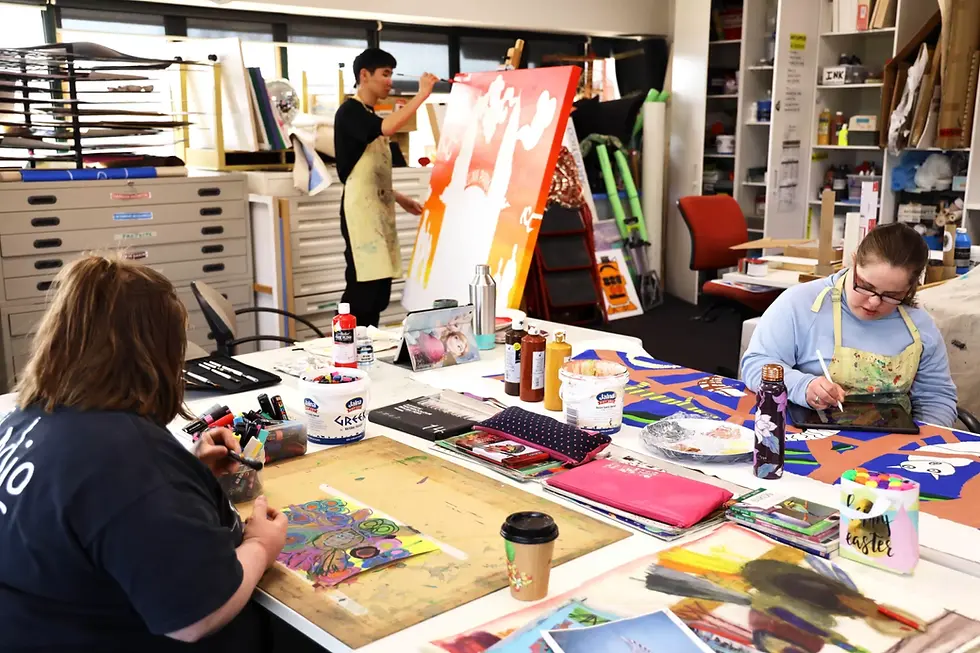
This is one of many ways to experience information. Understanding these differences isn’t just clinical - it’s creative. It allows us to notice the range of ways people process their environments, especially in spaces that are asking something of us - like a studio.
Association and the Facilitator’s Role
Facilitating artists don’t just help people receive information. They help people make meaning with it.
They pay attention to how information links to experience -
how a sound connects to an action,
how a material brings up a memory,
how a color, word, or rhythm opens a new pathway.
They aren’t just “helpers.” They are practitioners of attention, attunement, and timing.
They adjust the environment not to control outcomes, but to let relationships form between a person and their materials, ideas, and actions.
They understand that information becomes meaningful through association.
And so, they make space for that linking to unfold - slowly, personally, creatively.
Because in the end, information doesn’t just arrive.
It settles.
It links.
It resonates.
And when it does, it becomes something to work with.


Comments