top of page


Writing
Through essays and ongoing writing, Creativity-Ability examines how creative practices develop, how studios generate knowledge, and how facilitation can make space for discovery.
These pieces consider progressive studio practice alongside broader questions of creativity, attention, uncertainty, and learning.


Studios Create Knowledge
Artists and Facilitators at work in the Nahiarte studio in Bilbao, Spain. Walk into almost any shared art studio and something becomes immediately apparent. Something else becomes immediately apparent. Knowledge is everywhere. A canvas is being stretched. Clay is being folded. Paint is being mixed. Someone notices another artist solving a problem in a way they hadn't considered before. Much of what is learned in a studio isn't taught through instruction. Someone sees a brush
Aug 6

What's Found Before It's Known?
Artists at work at Die Schlumper studio and gallery. Hamburg, Germany. Creativity is often described as a form of problem-solving. There is certainly truth in this. Creativity can help solve problems. But over the past two decades of facilitating creative practices, one pattern has become clear. Within an artistic or creative studio practice, creativity often serves a different purpose. A problem is not what initiates movement. Interest is. What is encountered first is uncert
Jul 13


What Does Getting Better Look Like?
Artist Sergei Eremichev displaying his work, made at Perspektiv art studio in Peterhof, Russia How does a facilitator know when someone is getting better in their creative practice? The question appears simple. Often it is answered by looking at the work. Compare today's drawing to last year's drawing. Compare the current painting to an earlier one. Identify what has improved. But much of what develops within a creative practice is not visible in the finished work. Curiosity
Jun 9


What Counts as Technique?
Artist Richard Nesbitt working at the ArtsWork studio, part of Autism Services, Inc. and now a part of People, Inc. Buffalo, NY, USA There is considerable historical, aesthetic, and intellectual investment in the idea of technique. When we encounter a work understood as technically masterful, we recognize that years of sustained attention have been embedded within it. The object holds evidence of time at a scale too large to precisely locate. Not simply t
May 27

What is Made Available
In a progressive studio, collaboration is often described as something that happens between an artist and a facilitating artist. And it does. But that is only the most visible layer. There is another collaboration happening at all times - less named, but just as formative. What is made available between facilitating artists. A studio is not neutral. It is shaped by what is introduced, what remains within reach, what is returned to. No single facilitator determines this. It
May 8


Taste Is Built Through Exposure
Artist Dan Carey using an overhead projector to begin a portrait of actor Ron Glass. ArtsWork at Autism Services, Inc. (now part of People, Inc.), Buffalo, NY, USA. Taste is not singular. It develops differently across environments. Shaped by what someone has the opportunity to encounter, notice, and return to. It is built over time. If the range of work one is exposed to is narrow, then taste develops within that range. Not because of a lack of ability. But because of a l
May 1


What's Found While Wandering
Artist Richard Nesbitt working at ArtsWork studio at Autism Services, Inc. in 2009. Buffalo, NY USA There are things we go looking for. And there are things that find us. Most systems are built to reward the first. Clear questions. Defined outcomes. Efficient paths between the two. You identify what is needed, you move toward it, you acquire it. It is measurable. Confirmable. It feels like progress. But there is another kind of information. It does not present itself as an an
Apr 22


Shaping a Relationship to Challenge
Artist Tom O'Sullivan at work in the Crawford Supported Studio , Ireland There are elements of the world we do not get to opt out of. Sound. Smell. Time passing. Sharing space. Friction. And challenge. In a studio practice, challenge is not an interruption. It is one of the conditions of it. It will arrive uninvited. It is also something worthy of being sought. Materials resist. Ideas often do not form the way they felt like they should. Tools can be sharpened. Processe
Apr 4


You Can Build the Ship, But You Can’t Control the Waves
Artists at work at ECF Art Centers . Inglewood, CA, USA A studio practice can be understood like building and maintaining a ship. You spend time crafting the best sails you can. You shape strong oars. You tinker with the compass. You learn the rigging and how the boat responds when you shift your weight. All of this matters. Skill, preparation, and care determine how well the ship can move in the water. But you can’t control the waves. They will rise when they rise. Curr
Mar 25


Anything of Real Value Takes Longer
Artists and staff at work at Center for Creative Works in Philadelphia, Pennsylvania, USA. There is a response from the world when an idea is placed into it. Not a guaranteed success. Not immediate clarity. But a response. Something shifts. Something pushes back. Something surprises you. An idea may take some time to sift into where it belongs. That response has very little to do with whether something was finished "on time." It has much more to do with whether the person pl
Mar 12


After The Sock Is On
Artist Therese Persson working at Inuti in Stockholm, Sweden. A good direct support provider, assisting with daily tasks, understands that even choosing a sock is an opportunity to help someone understand options - texture, elasticity, tightness, warmth, how it feels inside a shoe, how it feels on a rug. And even that attentive moment carries more than it appears to. The information in a sock does not end when it is put on. A facilitating artist recognizes that this cont
Feb 27


Riding the Wave Between Divergence and Convergence
Mawaheb Studio . Dubai, UAE Creativity is often described as a movement between two modes: Divergence — generating options, expanding possibilities, allowing variation. Convergence — selecting, refining, deciding, shaping toward form. In studio settings, both are necessary. But neither is neutral. Divergence without eventual convergence becomes diffuse - a field of endless possibility with no traction. Convergence without prior divergence becomes rigid - a narrowing that fo
Feb 19


When the Trick Surprises the Magician
An artist at work at Studio A in Sydney, Australia I’ve been thinking about the moments in magic that matter most - not the reveal itself, but the split second before it. The magician is most alive not when everything goes as planned, but when preparation creates the conditions for something unexpected to appear - even to them. I’m especially interested in the idea of a magician surprising themselves. A card appears where it shouldn’t be. Not because the trick failed, but
Feb 5
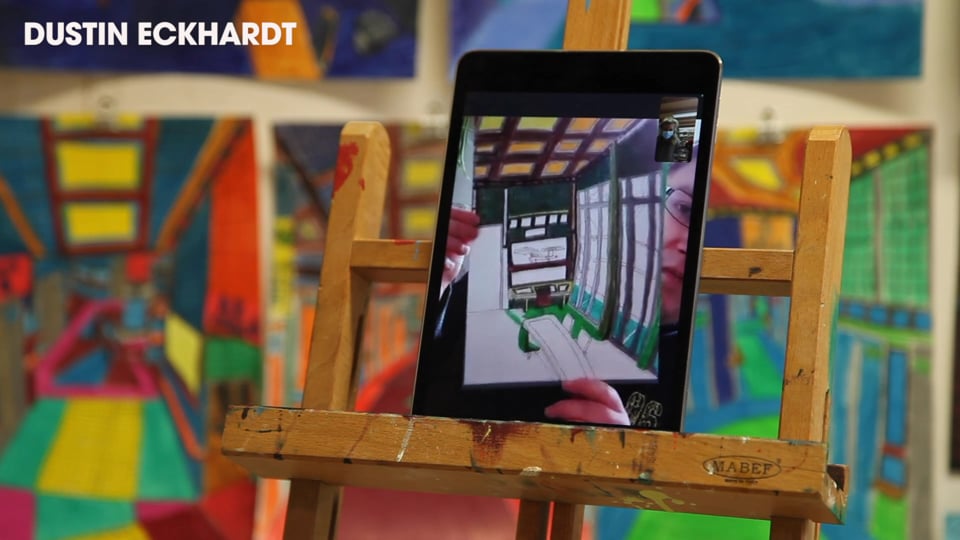
Where Does Familiarity Live?
A short video of artist Tina Herchenröther working at Atelier Goldstein, Frankfurt, Germany. Facilitation is not about accelerating understanding. It is about holding space long enough for understanding to find its own body. In many support settings, understanding is treated as something that must appear quickly and visibly - often through words. We ask for explanation. We look for reflection. We wait for language to confirm that something meaningful has occurred. But familia
Jan 16


At the Edge of Finding Out
Turner Prize winning artist Nnena Kalu, who has studio practice at ActionSpace in London, England. Discovery isn’t a deliverable. It’s not a thing to be handed over, translated, or explained in advance. It’s an event. It’s something you approach, hesitate at, and eventually step into. And importantly, it’s an event that only works - at a deep, lasting level - when the person who encounters it is also the author of that moment, even as the conditions of the environment
Jan 7


Experiences over Explanation
Artist Kaya Eccles and a facilitator working at Jump the Moon studio in Logan, Utah, USA Some experiences don’t have a shorthand. Before preferences can be named, before decisions can be made, an experience has to be legible - and not everything becomes legible through explanation. This is especially true in supported studio environments, where explanation can sometimes outpace recognition. I’ve seen this clearly in moments where an experience had to be entered before
Jan 1


Decisions Over Destination
Artist Linda Bell installing her work at the A New Direction, I Am Festival, in London 2022 Choice and decision are often used interchangeably, but they don’t always function in the same way. A choice can be made repeatedly without consequence. It can be habitual, automatic, even invisible. If a drawer holds six identical pairs of socks, reaching for the nearest pair each morning requires no interpretation, no reflection, and no deduction. The act is technically a choice,
Dec 17, 2025


Cauldron of Ideas
Studio Incurve, Osaka, Japan. Creativity is often described as a path, a progression, a series of steps that lead toward something finished. But the actual lived experience of making - especially in supported studios and other long-term creative environments - is rarely linear. It behaves far more like a cauldron. Ideas enter from different angles. Experiences settle at different depths. Influences mix, collide, and dissolve into one another. There is heat, there is time,
Dec 10, 2025


Information Out in the Open
ActionSpace's Studio Voltaire, London, England Some environments teach without structuring themselves as classrooms. In supported studios, instruction certainly happens at times - a facilitating artist may show someone a process they want to learn, and formal guidance can appear when it’s useful - but much of the knowledge in these spaces moves through osmosis. It circulates through gestures, rhythms, attention, and proximity. People absorb what they need by being attuned t
Dec 2, 2025


Time is Material
Creativity Explored. San Francisco, California, USA. Most educational spaces compress time. Whether it’s a semester, a training period, or a curriculum designed in advance, the rhythm is the same: time is tightened so achievement can be demonstrated. Progress is measured by how efficiently someone moves from not knowing to knowing, guided by instructors who already know the destination. Supported studios are educational spaces in that people gain knowledge, and the know-how
Nov 21, 2025


bottom of page